
Interview Preparation Platform with AI-Driven Mock Interviews
Most candidates walk into interviews underprepared—not because they lack skills, but because they've never practiced under real conditions. We built Interview AI Prep from the ground up: a platform where an AI interviewer asks real questions, grades answers in real-time, and tells you exactly what to fix before the actual call.
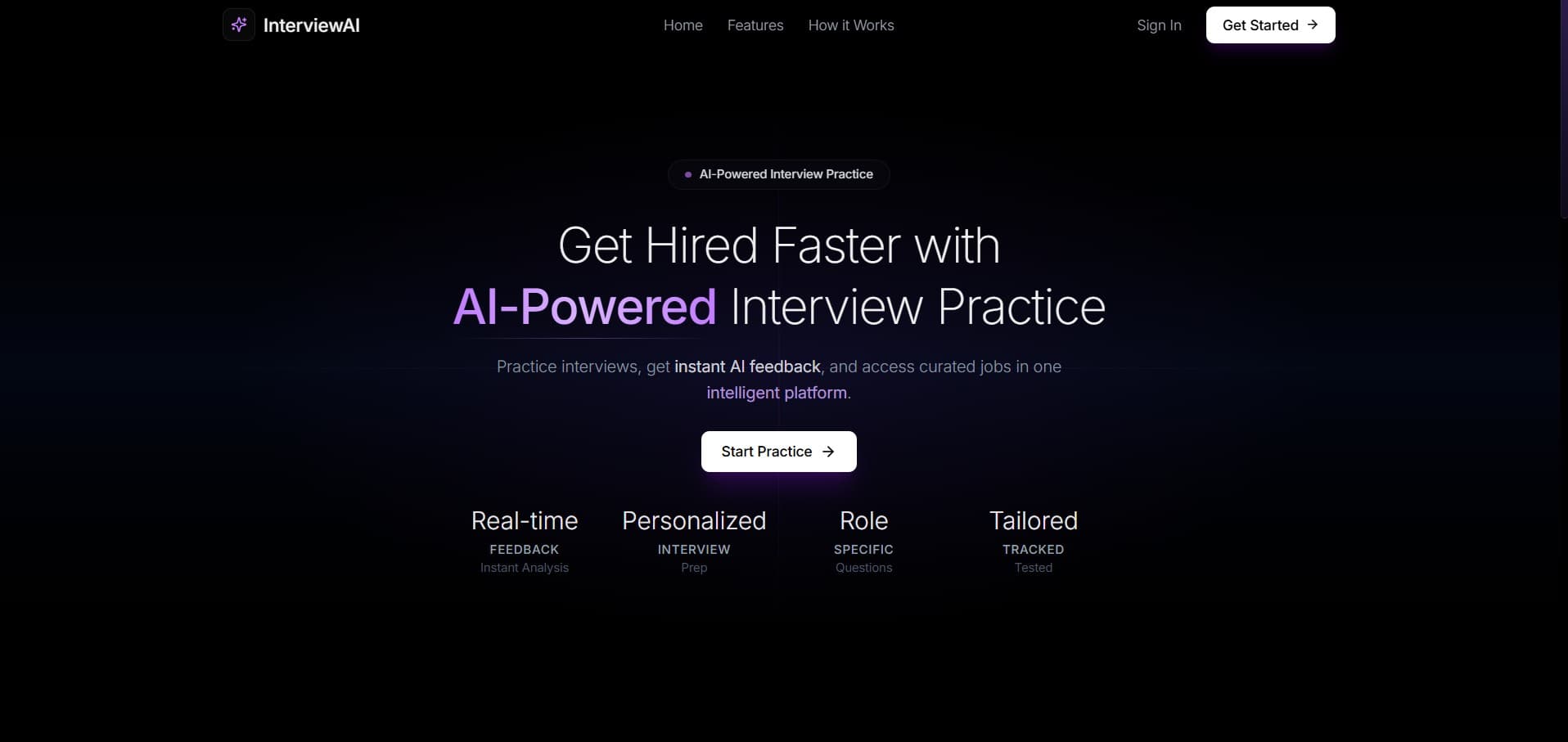
Interview AI Prep was founded on a simple but painful observation: the gap between a qualified candidate and a hired candidate is almost entirely practice. Traditional preparation—reading guides, watching YouTube, doing mock calls with friends—is unstructured, inconsistent, and doesn't simulate the pressure of a real interview. The founder needed a platform that could replicate that pressure at scale, give honest feedback, and adapt to each user's weak spots.
The Challenge
Building a convincing AI interviewer is deceptively hard. The system needed to ask contextually intelligent follow-up questions, evaluate answers across multiple dimensions—relevance, clarity, structure, confidence—and deliver feedback that felt coaching-level, not robotic. On top of that, the platform had to handle real-time voice transcription without the latency killing the interview flow.
- Real-time speech-to-text transcription needed to keep pace with natural speech without perceptible lag
- AI follow-up questions had to feel contextual and human, not scripted or repetitive across sessions
- Feedback scoring needed to go beyond keyword matching—evaluating structure, specificity, and communication clarity
- User analytics had to surface meaningful progress trends, not just raw session logs, to keep users motivated
Our Approach
We architected the platform from a blank repository, designing every layer—frontend experience, AI pipeline, and analytics engine—around the core product loop: practice, get scored, improve, repeat.
Frontend — Next.js 14 Interview UI
We built the interview interface as a distraction-free, single-screen experience using Next.js 14 and React. A live waveform visualizer gives users audio feedback while speaking, and a real-time transcript panel updates as they talk—keeping the session feel natural and grounded. Between questions, animated transitions hold attention without breaking flow.
AI Interview Engine — LangChain & OpenAI
The core interviewer is a multi-turn LangChain agent built on OpenAI's GPT-4o. Each session is initialized with the user's target role, years of experience, and past session weaknesses. The agent dynamically selects from a curated question bank, generates contextual follow-ups based on the candidate's actual answers, and maintains session memory to avoid repetition—making every mock feel unique.
Real-Time Voice Transcription — Whisper API
We integrated OpenAI's Whisper API for speech-to-text, streaming audio chunks from the browser in near real-time. To keep feedback latency under 1.2 seconds, we built a lightweight Node.js audio proxy that buffers, compresses, and forwards audio segments concurrently with the LLM scoring pipeline—so transcription and evaluation run in parallel, not sequentially.
Scoring & Analytics Engine
Each answer is evaluated across four rubric dimensions: relevance to the question, structural clarity (STAR method compliance), specificity of examples, and communication confidence signals. Scores are stored per-question in MongoDB and aggregated into session-level and trend-level dashboards. Redis caches the active rubric configs so scoring calls never hit cold storage during a live session.
Results & Business Impact
The platform launched within eight weeks of kickoff and immediately gained traction among users preparing for product, engineering, and consulting roles. The AI feedback loop proved accurate enough that users reported a 2× improvement in their real-interview pass rates after completing structured practice flows on the platform.
Average AI feedback latency held under 1.2 seconds even under concurrent session load—keeping the interview immersion intact. User retention is driven by the analytics dashboard: seeing objective score improvements across sessions is the hook that brings candidates back daily in the weeks before their actual interviews.